
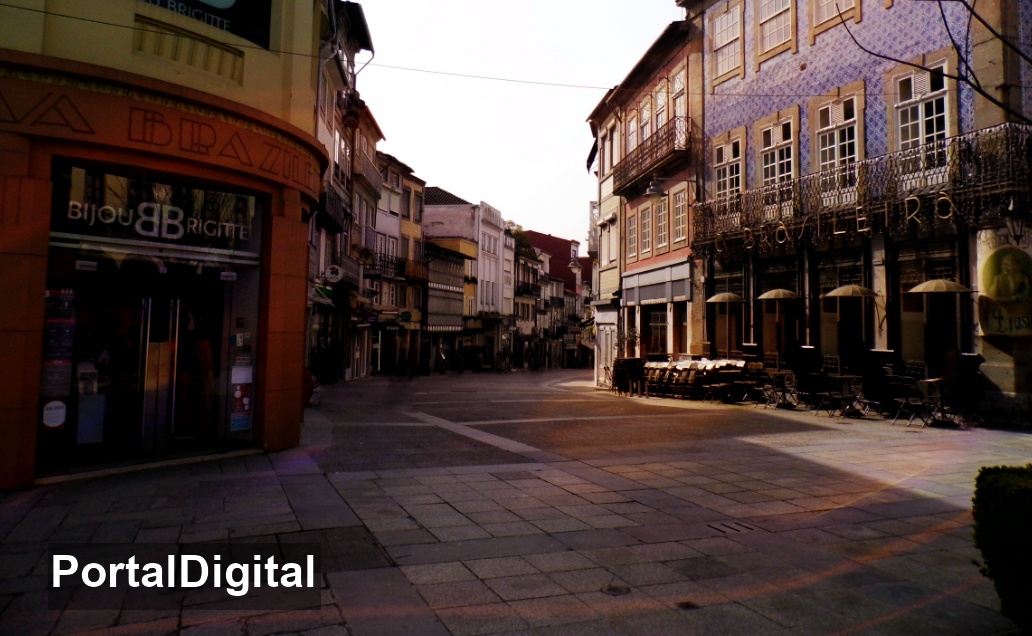
Rua do Souto, in Braga
Largo do Barão de São Martinho is in the historic center, being an obligatory crossing point to enter the centuries-old city itself, it is located between Rua do Souto (a pedestrian and commercial street) and Praça da República, city of Braga, northern Portugal.
The Characteristics of Largo do Barão de São Martinho in Braga
Largo do Barão de São Martinho is at the entrance to the historic area where there are many restored old buildings that feature blue tiles on the facade, and the walls open portals taking us to times gone by where the memory is clearly evident on the exterior of the facades, whether in the structures, windows and balconies.
In this square we also find the oldest and most popular café, "Café A Brasileira" with large terraces and on the left side giving access to Rua de São Marcos.
This Largo is in an area where no vehicles pass, and where there are many commercial stores such as: perfumery stores, stores selling jewelry and accessories, jewelry stores, a historic cafe with large terraces, an ice cream store, insurance companies and some banks.
In the Largo there are some small trees, bushes as flowerbeds and a stone sidewalk and it has a rectangular area with large dimensions where people can move around at will.
In Largo do Barão de São Martinho, the “Café A Brasileira” and the “Torre de Menagem” stand out.
In this square we also find the oldest and most popular café, "Café A Brasileira" with large terraces and on the left side giving access to Rua de São Marcos.
This Largo is in an area where no vehicles pass, and where there are many commercial stores such as: perfumery stores, stores selling jewelry and accessories, jewelry stores, a historic cafe with large terraces, an ice cream store, insurance companies and some banks.
In the Largo there are some small trees, bushes as flowerbeds and a stone sidewalk and it has a rectangular area with large dimensions where people can move around at will.
In Largo do Barão de São Martinho, the “Café A Brasileira” and the “Torre de Menagem” stand out.
Café a Brasileira in Braga
Café a Brasileira is located in Largo Barão de São Martinho in the heart of the city's historic center and underwent works in 2009, the project being designed by architect Sérgio Borges.
The History of Brazilian Coffee in Braga
The establishment was founded by Adriano Soares Teles do Vale, born in Casa de Cimo da Aldeia in Alvarenga (Arouca), in the municipality of Arouca, in the Porto Metropolitan Area.
In 1937, the café was acquired by Joaquim Queirós, who maintained it for the next four decades, and integrated the neighboring Café Sport (in the lower part of the café).
In 1977 it was passed to Joaquim Domingos Godinho, and years later, the café underwent important restoration and modernization works with a project by architect Sérgio Borges who recreated a café that had been lost until then (2008-2009).
In 1937, the café was acquired by Joaquim Queirós, who maintained it for the next four decades, and integrated the neighboring Café Sport (in the lower part of the café).
In 1977 it was passed to Joaquim Domingos Godinho, and years later, the café underwent important restoration and modernization works with a project by architect Sérgio Borges who recreated a café that had been lost until then (2008-2009).
The Characteristics of Brazilian Coffee in Braga
Inside the Café, the upper floors are available to the public, on the ground floor there are small hexagonal mirrors, the service counter has been modernized, the floor is made of "azulino cascais" marble, a stone widely used at the time.
The art deco style letters were repositioned to enhance their presence on the facades, the image of the "Brazilian" topping the arch, the original café letters located over the service counter and gouache paintings with themes on various sports in art deco style which are now displayed in the rooms on the upper floor.
In the decorative part, all the original furniture was restored, and glass cups with metal saucers were introduced to serve the famous bag coffee of the establishment, which still sells and serves ground coffee in its own machine as it has always been done.
Currently, the Café has an art deco style: columns imitating marble, materials made of chrome plating, stainless steel and plastic, geometric decoration with decorative objects such as sculptures, lamps and furniture with stylized motifs with bouquets of flowers giving a modernist air.
The art deco style letters were repositioned to enhance their presence on the facades, the image of the "Brazilian" topping the arch, the original café letters located over the service counter and gouache paintings with themes on various sports in art deco style which are now displayed in the rooms on the upper floor.
In the decorative part, all the original furniture was restored, and glass cups with metal saucers were introduced to serve the famous bag coffee of the establishment, which still sells and serves ground coffee in its own machine as it has always been done.
Currently, the Café has an art deco style: columns imitating marble, materials made of chrome plating, stainless steel and plastic, geometric decoration with decorative objects such as sculptures, lamps and furniture with stylized motifs with bouquets of flowers giving a modernist air.
The Keep in Braga
To the east, the keep which is the main remnant of the castle built under the reign of D. Dinis.
The History of the Keep in Braga
From the 13th century onwards, a new construction phase began, under the reign of D. Dinis, a new fence was started, complemented by a keep.
The works progressed slowly and, during the reign of D. Fernando (1367-1383) the new fence proved ineffective, allowing troops from Castile to invade the city in the 1370s.
From the 16th century onwards, the loss of its defensive function was proven by the number of buildings that extended beyond the fence, and Braga Castle was demolished (1906), leaving only its Keep.
Later, the Keep and some sections of the medieval wall were classified as a National Monument by Decree published on June 24, 1910.
The works progressed slowly and, during the reign of D. Fernando (1367-1383) the new fence proved ineffective, allowing troops from Castile to invade the city in the 1370s.
From the 16th century onwards, the loss of its defensive function was proven by the number of buildings that extended beyond the fence, and Braga Castle was demolished (1906), leaving only its Keep.
Later, the Keep and some sections of the medieval wall were classified as a National Monument by Decree published on June 24, 1910.
The Characteristics of the Keep in Braga
This tower has a square plan, on the facade we see the Gothic style, and has a height of approximately thirty meters divided internally into three floors.
At the top there is a semi-detached window and boulders at the apexes, at the top a crown of battlements, in the tower and on the west elevation there are the coat of arms of D. Dinis.
At the top there is a semi-detached window and boulders at the apexes, at the top a crown of battlements, in the tower and on the west elevation there are the coat of arms of D. Dinis.