
Largo de Santa Cruz, in Braga
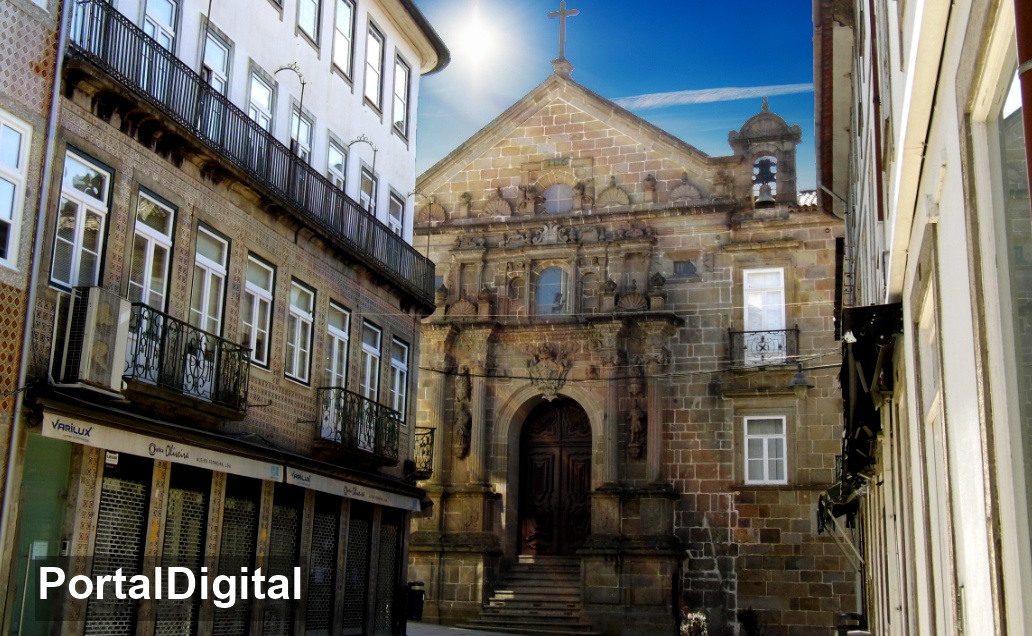
The Misericórdia Church is located in the parish of Sé, in the heart of the historic center, city of Braga, northern Portugal.
This Church has a Renaissance style unique to the city, and is included in the set of buildings of the Braga Cathedral, and belongs to the Santa Casa da Misericórdia de Braga.
On slightly uneven ground, on the corner of Rua D. Diogo de Sousa and Praça de D. João Peculiar, connected to a closed courtyard, known as the cloister of Santo Amaro or São Geraldo, of the Braga Cathedral, with which it has internal communication.
Nearby is the Old Archbishop's Palace of Braga, the Braga City Hall and the Pelicano Fountain.
This Church has a Renaissance style unique to the city, and is included in the set of buildings of the Braga Cathedral, and belongs to the Santa Casa da Misericórdia de Braga.
On slightly uneven ground, on the corner of Rua D. Diogo de Sousa and Praça de D. João Peculiar, connected to a closed courtyard, known as the cloister of Santo Amaro or São Geraldo, of the Braga Cathedral, with which it has internal communication.
Nearby is the Old Archbishop's Palace of Braga, the Braga City Hall and the Pelicano Fountain.
History
Between 1560-1562 this church was built during the time of Archbishop D. Frei Bartolomeu dos Mártires (1559-1558).
This temple was founded in 1513, the Irmandade da Misericórdia de Braga had permission from D. Diogo de Sousa, Archbishop of the city, to install itself in one of the chapels in the cloister of the Cathedral, then designated as Capela de Jesus da Misericórdia.
In 1558, the brothers decided to build a new temple located next to the Cathedral, and the design of this temple is attributed to the architect Manuel Luís, master of Porto who created the main chapel of Misericórdia do Porto.
The construction of the temple began around 1560, with the date "1562" engraved on the main portal, probably indicating the date on which the facade was completed.
Over the centuries it was subject to several renovations, acquiring its current appearance in 1891.
This temple was founded in 1513, the Irmandade da Misericórdia de Braga had permission from D. Diogo de Sousa, Archbishop of the city, to install itself in one of the chapels in the cloister of the Cathedral, then designated as Capela de Jesus da Misericórdia.
In 1558, the brothers decided to build a new temple located next to the Cathedral, and the design of this temple is attributed to the architect Manuel Luís, master of Porto who created the main chapel of Misericórdia do Porto.
The construction of the temple began around 1560, with the date "1562" engraved on the main portal, probably indicating the date on which the facade was completed.
Over the centuries it was subject to several renovations, acquiring its current appearance in 1891.
Facade
This building has a longitudinal plan, with a single nave, with a rectangular Casa do Despacho attached to the main facade forming an L shape.
The building features Mannerist facades, particularly evident through the church portals, namely on the main facade, with an altarpiece portal, running the entire height of the facade, combining a Mannerist structure, Renaissance decorative elements, and some baroque elements introduced later, such as the coat of arms of Archbishop D. Gaspar de Bragança.
It features two registers supported by striated composite columns with a Serlian motif in the second register, using decorative elements such as medallions with busts, shells and pinnacles.
A Side portal, simpler framed by striated composite columns topped by a sculptural group. The portals feature excellent stonework, contrasting the sobriety of the facades with the exuberance of the portals, particularly notable in the main one, which fills the entire facade, combining a series of elements, such as pinnacles and large shells.
The set of baked clay statuary on the side portal, as well as its architectural integration, constitute a rare example of the Mannerist conception of framing sculptural elements on a facade.
The building features Mannerist facades, particularly evident through the church portals, namely on the main facade, with an altarpiece portal, running the entire height of the facade, combining a Mannerist structure, Renaissance decorative elements, and some baroque elements introduced later, such as the coat of arms of Archbishop D. Gaspar de Bragança.
It features two registers supported by striated composite columns with a Serlian motif in the second register, using decorative elements such as medallions with busts, shells and pinnacles.
A Side portal, simpler framed by striated composite columns topped by a sculptural group. The portals feature excellent stonework, contrasting the sobriety of the facades with the exuberance of the portals, particularly notable in the main one, which fills the entire facade, combining a series of elements, such as pinnacles and large shells.
The set of baked clay statuary on the side portal, as well as its architectural integration, constitute a rare example of the Mannerist conception of framing sculptural elements on a facade.
Interior
The first works to decorate the interior space, with the construction of several altarpieces sponsored by the brothers who wanted to be buried inside the temple
The records of the Misericórdia de Braga indicate that in 1577 the brotherhood hired the painter António Juzarte to create the paintings integrated into a side altarpiece located on the Epistle side, whose carving was created by the masters Lucas Fernandes and Jácome Pires.
In 1590, the painter from Braga Francisco Soares was hired to fresco the ceiling of the low choir, which was to be painted with "Roman motifs in a “brutesque" manner.
Throughout the 17th century, the brotherhood paid for decoration, remodeling, restoration and expansion of its spaces.
In 1603, the church's pillars and altarpieces were repaired and gilded again, in work carried out by Paulo Soares, and in 1624 Francisco Vaz, master bricklayer, and Francisco João, carpenter, were hired to build the Casa do Despacho, according to a plan drawn up by Father Geraldo Álvares.
In 1656, Gonçalo Pacheco and João de Oliveira built the coffered ceiling that covers the nave, and between 1662 and 1664 the tile panels were placed inside the temple.
In the last quarter of the 16th century, major works were carried out in the temple's decorative program.
In 1679 the Misericórdia hired the sculptor Belchior Fernandes to redo the central altarpiece located on the altar of Our Lady, and the collateral ones, at the same time that the stone master Manuel Carvalho was finishing a stone altarpiece, the design of which had been done years before by Frei José de Braga.
Throughout the 18th century, more improvement works were carried out, such as the execution of new carved altarpieces, which replaced those by Belchior Fernandes.
The Misericórdia church in Braga is a longitudinal temple, with a single nave, forming an L-shaped ensemble with the Casa do Despacho.
As a whole, it presents two very distinct languages, the Mannerist structure in Flemish taste, and the Baroque decorative program, which was built throughout the 17th and 18th centuries.
The temple project designed by Manuel Luís demonstrates a knowledge of the most erudite Mannerist models, highlighting the main façade in Flemish language, very similar to that of the temple of São Domingos de Viana do Castelo, designed by João Lopes o Moço at the same time, and which would serve as inspiration for later works built in northwestern Portugal, such as the temple of São Gonçalo de Amarante, or the Misericórdia de Guimarães.
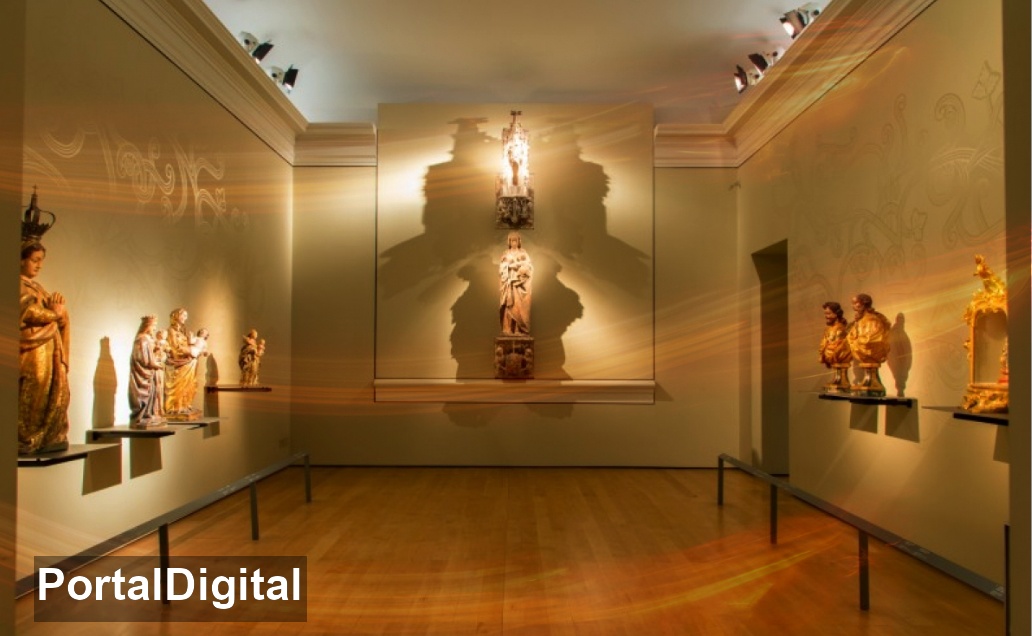
The altarpieces with excellent carving work, and the furniture in the sacristy, the main altarpiece with Johannine baroque, and a neoclassical organ are also worth highlighting.
This temple consists of a nave covered by a wooden vault decorated with coffers, painted with finials, with the arms of Mercy in the center.
The wooden High Choir stands out in the center in a semicircle with a guard on a wooden balustrade, and on the Gospel side there is a carved organ decorated with garlands.
The Presbytery is separated by a wooden balustrade communion railing.
The front wall is entirely filled by the main altarpiece, of gilded carving, straight plan and three registers, topped by a central aedicule, protected by a canopy, flanked by angels and pedestals with imagery and a canopy.
The Tribune in full arch with resplendence in the beam having a painted canvas with the representation of the Mater Omnium.
The side axes are treated with cut-out niches housing imagery, over other smaller niches, also with imagery, inscribed in full arches on pilasters with phytomorphic decoration, and the straight altar with high polychrome relief depicting the Miracle of the multiplication of the loaves and fish.
Casa do Despacho has a main facade in granite stonework (the craft or art of carving blocks of rough rock to form solids), to the North, in continuity with the main facade of the church topped with a cornice under a projecting eaves.
At the E. end of the eaves, flanking the church's finishing pediment, there is a bell tower topped by a curved pediment, with volutes at the ends, a shell tympanum and crowned by a spire.
It has three registers, the first being limited by a frieze, torn by two portals with straight lintels, topped by a straight cornice, and by small openings and facing windows.
The second register is regularly torn by two pairs of straight-lintel windows, topped by a straight cornice, surmounted by bay windows, with an iron guard of identical morphology forming the last register.
The records of the Misericórdia de Braga indicate that in 1577 the brotherhood hired the painter António Juzarte to create the paintings integrated into a side altarpiece located on the Epistle side, whose carving was created by the masters Lucas Fernandes and Jácome Pires.
In 1590, the painter from Braga Francisco Soares was hired to fresco the ceiling of the low choir, which was to be painted with "Roman motifs in a “brutesque" manner.
Throughout the 17th century, the brotherhood paid for decoration, remodeling, restoration and expansion of its spaces.
In 1603, the church's pillars and altarpieces were repaired and gilded again, in work carried out by Paulo Soares, and in 1624 Francisco Vaz, master bricklayer, and Francisco João, carpenter, were hired to build the Casa do Despacho, according to a plan drawn up by Father Geraldo Álvares.
In 1656, Gonçalo Pacheco and João de Oliveira built the coffered ceiling that covers the nave, and between 1662 and 1664 the tile panels were placed inside the temple.
In the last quarter of the 16th century, major works were carried out in the temple's decorative program.
In 1679 the Misericórdia hired the sculptor Belchior Fernandes to redo the central altarpiece located on the altar of Our Lady, and the collateral ones, at the same time that the stone master Manuel Carvalho was finishing a stone altarpiece, the design of which had been done years before by Frei José de Braga.
Throughout the 18th century, more improvement works were carried out, such as the execution of new carved altarpieces, which replaced those by Belchior Fernandes.
The Misericórdia church in Braga is a longitudinal temple, with a single nave, forming an L-shaped ensemble with the Casa do Despacho.
As a whole, it presents two very distinct languages, the Mannerist structure in Flemish taste, and the Baroque decorative program, which was built throughout the 17th and 18th centuries.
The temple project designed by Manuel Luís demonstrates a knowledge of the most erudite Mannerist models, highlighting the main façade in Flemish language, very similar to that of the temple of São Domingos de Viana do Castelo, designed by João Lopes o Moço at the same time, and which would serve as inspiration for later works built in northwestern Portugal, such as the temple of São Gonçalo de Amarante, or the Misericórdia de Guimarães.
The altarpieces with excellent carving work, and the furniture in the sacristy, the main altarpiece with Johannine baroque, and a neoclassical organ are also worth highlighting.
This temple consists of a nave covered by a wooden vault decorated with coffers, painted with finials, with the arms of Mercy in the center.
The wooden High Choir stands out in the center in a semicircle with a guard on a wooden balustrade, and on the Gospel side there is a carved organ decorated with garlands.
The Presbytery is separated by a wooden balustrade communion railing.
The front wall is entirely filled by the main altarpiece, of gilded carving, straight plan and three registers, topped by a central aedicule, protected by a canopy, flanked by angels and pedestals with imagery and a canopy.
The Tribune in full arch with resplendence in the beam having a painted canvas with the representation of the Mater Omnium.
The side axes are treated with cut-out niches housing imagery, over other smaller niches, also with imagery, inscribed in full arches on pilasters with phytomorphic decoration, and the straight altar with high polychrome relief depicting the Miracle of the multiplication of the loaves and fish.
Casa do Despacho has a main facade in granite stonework (the craft or art of carving blocks of rough rock to form solids), to the North, in continuity with the main facade of the church topped with a cornice under a projecting eaves.
At the E. end of the eaves, flanking the church's finishing pediment, there is a bell tower topped by a curved pediment, with volutes at the ends, a shell tympanum and crowned by a spire.
It has three registers, the first being limited by a frieze, torn by two portals with straight lintels, topped by a straight cornice, and by small openings and facing windows.
The second register is regularly torn by two pairs of straight-lintel windows, topped by a straight cornice, surmounted by bay windows, with an iron guard of identical morphology forming the last register.
Classification
It has been classified as a Property of Public Interest since 1977.